Current language:
The number of registered
animals is growing every day
Published: Aug 14, 2026
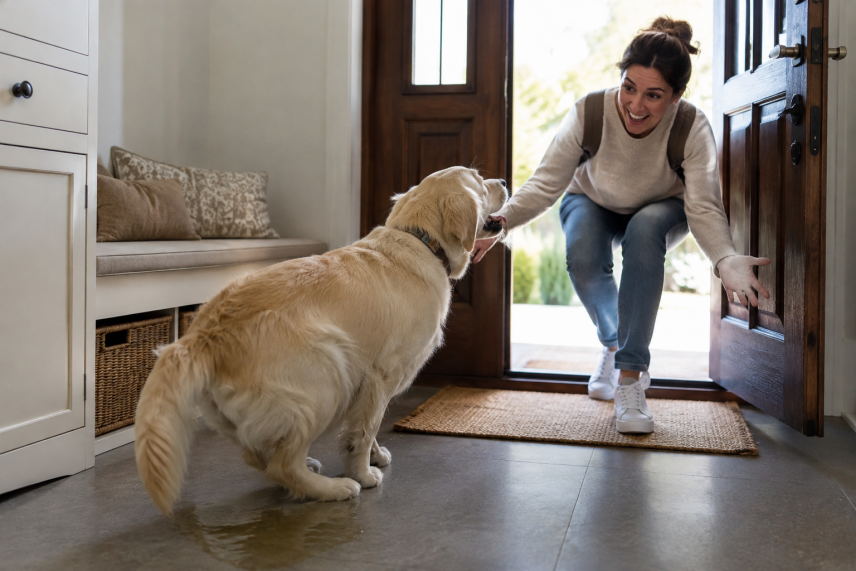
If you have ever wondered, “why does my dog pee when greeting people?”, the most important thing to know is that the behavior is usually involuntary. A dog may urinate during a greeting because of intense excitement, stress, fear, insecurity, submissive behavior, or, especially in puppies, immature bladder control.
It is not accurate to assume that every dog who pees during a greeting is simply “so happy.” Some dogs are excited, while others are overwhelmed, uncertain, or trying to appease the person approaching them. In some cases, several emotions can occur at the same time.
The good news is that peeing during greetings can often improve with calmer interactions, appropriate management, reward-based training, and maturity. However, a sudden change in urination in an adult dog should not automatically be treated as a behavior problem because medical conditions can also cause urinary accidents.
There are several possible explanations for urinating when someone arrives, approaches, touches, or speaks excitedly to a dog.
Excitement urination in dogs happens when a dog becomes so highly aroused that urine is released during an emotionally intense interaction. This may happen when you return home, when visitors arrive, or when the dog receives enthusiastic attention.
An excited dog may jump, spin, wag intensely, rush toward the person, vocalize, or struggle to stay still. The urination is not deliberate. The problem is usually the intensity of the emotional response rather than a lack of house training.
Submissive urination in dogs is associated with appeasing or uncertain body language. A dog may lower its body, tuck its tail, pull its ears back, avoid eye contact, crouch, turn away, or roll partly onto its back.
This type of urination can occur when someone approaches the dog, stands over it, reaches toward it, speaks loudly, or makes direct eye contact. What may look like “guilty” behavior is more likely to reflect uncertainty, fear, or an attempt to avoid conflict.
Fear and excitement are not always easy to separate. A dog can want to greet someone while simultaneously feeling overwhelmed by the interaction. This can create a mixture of excitement, anxiety, and appeasing behavior.
For example, a dog may run toward a visitor but then crouch, pull its ears back, or urinate when the visitor bends down. The dog is socially interested but unable to cope comfortably with the intensity of the interaction.
Young dogs are particularly likely to have accidents during emotionally intense situations. Puppies are still learning appropriate elimination habits, developing bladder control, and learning how to regulate their responses to new experiences.
Many puppies improve as they mature, particularly when owners consistently provide calm greetings and reward appropriate behavior.
Even a confident dog can become too aroused during a greeting. Loud voices, jumping, running, repeated petting, and several people approaching at once can push an already excited dog beyond its ability to remain calm.
The goal is therefore not simply to prevent the urine from appearing. It is to change the greeting so that the dog does not become excessively excited, frightened, or overwhelmed in the first place.
If you are asking, “why does my puppy pee when excited?”, immature bladder control is part of the explanation, but it is not the whole story.
Puppies are still learning how to control elimination and how to respond to emotionally stimulating situations. A greeting can create a sudden surge of excitement that makes it difficult for a young dog to maintain control.
A puppy who pees when greeted is not necessarily confused about where it is supposed to urinate. A puppy can be successfully learning house training and still have occasional excitement-related accidents.
Puppies also have less experience regulating their emotions. A person coming through the door, an unfamiliar visitor, enthusiastic petting, or a high-energy voice can be a much bigger event for a puppy than it is for an adult dog.
Many puppies improve naturally as they mature, particularly when owners consistently provide calm greeting routines. It is better to help the puppy learn a calmer greeting rather than simply waiting for the problem to disappear.
Most importantly, accidents should not be interpreted as disobedience. Punishing a puppy for involuntary urination can increase fear or anxiety and may make the problem worse.
The two behaviors can look similar because both involve involuntary urination during social interactions. However, the dog's body language and emotional state can provide useful clues.
| Feature | Excitement urination | Submissive urination |
|---|---|---|
| Typical triggers | Returning home, enthusiastic greetings, visitors, vigorous play or petting | Direct approaches, unfamiliar people, looming over the dog, loud voices or intimidating interactions |
| Body language | Wiggling, jumping, spinning, intense tail wagging, rushing toward people | Crouching, lowered body, ears back, tail tucked, avoiding eye contact or rolling over |
| Emotional state | Highly excited and aroused | Uncertain, fearful, overwhelmed, or appeasing |
| When it occurs | Often at the peak of an energetic greeting | Often when the dog feels socially pressured |
| How the dog may appear | Happy but unable to regulate its excitement | Nervous, uncomfortable, or eager to avoid conflict |
| Main training goal | Reduce arousal and teach calm greetings | Increase confidence and make interactions feel safer and less threatening |
There can also be overlap. A dog can be excited to see someone while simultaneously feeling intimidated by that person's approach. Mixed emotional responses can make greeting-related urination difficult to classify based on the accident alone.
If your dog pees when I come home, the reunion itself may be the trigger.
After you have been away, your return can produce an unusually intense emotional response. Your dog may rush to greet you, jump, vocalize, wag its tail rapidly, and seek physical contact. If the arousal becomes too high, excitement-related urination can occur.
The same principle explains why a dog pees when visitors arrive. The doorbell, footsteps, voices, unfamiliar people entering the home, and anticipation of interaction can all contribute to a highly stimulating event.
Touch can also be a trigger. Some dogs experience excitement-related urination when they are petted vigorously. Others may urinate because the physical interaction feels socially intense or uncomfortable.
Things that can make greeting-related urination more likely include:
If you want to know how to stop a dog from peeing when excited, focus on reducing emotional intensity and teaching the dog what to do instead.
Enter quietly rather than immediately turning the reunion into a major event. Give your dog time to process your arrival.
Speak normally and avoid encouraging frantic jumping, squealing, running, or other behaviors that push your dog into an extremely aroused state.
If your dog is jumping, spinning, or rushing around, wait a moment before engaging. This gives the dog an opportunity to settle before interaction begins.
If petting reliably triggers urination, delay physical contact until your dog is calmer. For a fearful or submissive dog, allowing the dog to approach you can be particularly helpful.
When practical, give your dog an opportunity to urinate before an expected greeting or take the dog outside soon after you arrive. This reduces the likelihood that a full bladder will contribute to an accident.
Reward behaviors such as sitting, standing quietly, looking at you calmly, or going to a designated mat. Food rewards can help reinforce the behavior you want.
Instead of allowing the dog to rehearse frantic greetings, teach a simple routine:
Person arrives → dog goes to mat → dog remains calm → dog receives reward → greeting begins.
A “go to bed” or “go to mat” behavior can be particularly useful because it gives the dog a predictable alternative to jumping and rushing toward people.
Consistency matters. If you calmly manage greetings but visitors immediately bend over the dog and excitedly pet it, the dog may continue to become overwhelmed.
Use an appropriate enzymatic pet-urine cleaner so that residual odor does not remain. Avoid turning the cleanup into a dramatic event.
Punishment is especially inappropriate when the urination is related to fear or submission. It can increase anxiety and make future greetings more difficult.
Visitors can make a significant difference, particularly if the dog is nervous or submissive.
Ask guests to:
For some fearful dogs, the best initial greeting may involve ignoring the dog completely. Once the dog has settled, it can choose whether to approach the visitor.
An involuntary response cannot be corrected effectively through punishment. If fear or submission is involved, punishment can make the dog more worried about human approaches and potentially intensify the problem.
Behavioral explanations should never replace a veterinary assessment when urinary behavior changes or other symptoms are present.
Contact your veterinarian if:
Urinary accidents can have medical causes, including urinary tract problems, conditions that increase urine production, neurological problems, and urinary incontinence. A veterinarian can determine whether medical testing is appropriate.
If a dog repeatedly strains to urinate but produces little or no urine, veterinary attention should be sought promptly because urinary obstruction can be an emergency.
Your dog may become extremely excited when you appear, particularly after an absence. Some dogs release urine during this intense emotional response. If your dog instead crouches, avoids eye contact, lowers its body, or tucks its tail, fear or submissive behavior may be involved.
It can happen frequently in young dogs. Puppies are still developing bladder control and learning to regulate excitement. Calm greeting routines and reward-based training can help the behavior improve with maturity.
No. Excitement urination is associated primarily with high arousal, while submissive urination is associated with appeasing, fearful, or uncertain social behavior. However, the two can overlap in the same dog.
Make greetings less intense, wait for your dog to settle before touching it, provide regular opportunities to urinate outside, and reward calm alternative behaviors such as sitting or going to a mat.
If your dog becomes extremely excited, briefly reducing attention can help lower arousal. You do not have to ignore your dog for a long period. Wait for a calmer moment, then greet your dog quietly and gently.
No. If the urination is involuntary, punishment is unlikely to solve the underlying problem and can increase fear or anxiety. This is particularly important when submissive urination is involved.
Visitors can create a combination of excitement, anticipation, uncertainty, and social pressure. Doorbells, people entering the home, loud voices, direct approaches, and physical attention can all contribute to emotional urination.
Petting may increase excitement, particularly if it is vigorous or occurs during an already intense greeting. For a nervous dog, touching or reaching over the head may instead increase anxiety. Try waiting until the dog is calm and using brief, gentle contact.
Many young dogs improve as they mature, gain better bladder control, and become less overwhelmed by greetings. However, calm training and appropriate management can make the process easier.
A sudden change deserves more attention than a long-standing puppy behavior. Stress or changes in the dog's environment can play a role, but medical causes should also be considered. A veterinary examination is appropriate if the change is new or occurs alongside other urinary symptoms.
Look at the whole body rather than the urine alone. Crouching, lowered posture, ears pulled back, tail tucking, avoiding eye contact, turning away, or rolling onto the back can indicate a fearful or submissive emotional state.
Arrange a veterinary consultation if the urination is new or unusual, occurs outside greetings, becomes frequent, is accompanied by straining or pain, contains blood, occurs during sleep, or is associated with increased thirst or other signs of illness.
Peeing during greetings is usually not deliberate misbehavior. Dogs may urinate because they are extremely excited, overwhelmed, fearful, insecure, or displaying submissive behavior. Puppies are particularly prone to the problem because they are still developing bladder control and emotional regulation.
The most helpful response is to make greetings calm and predictable. Give the dog space, reduce intense eye contact and physical contact, allow the dog to settle, reward calm behavior, and teach an alternative greeting routine.
If your dog suddenly begins having urinary accidents, urinates in other situations, strains, shows pain, drinks excessively, leaks urine during sleep, or develops other symptoms, consult a veterinarian rather than assuming the cause is behavioral.
Check also:
Dog Socialization – How to Do It Properly
What Can’t Dogs Eat?
How to Care for Your Dog During Hot Weather?
Marking animals with a microchip is the most durable, effective and completely safe method of quick and reliable identification. Every transponder (chip) has a unique number which enables instant identification of the animal and its owner, helping them reunite faster. However, it is important to remember that a chip is just a transponder with an encoded number. It is not a tracking device and contains no data about the animal or the owner! Therefore, in order to identify a chipped dog or cat, it is necessary that a microchip be registered in a national marked animal database...
Read moreIn today's world, responsibility for animal care has become not only a priority for their owners but also a societal issue. One of the most important tools in ensuring animal safety is the chip database. It allows for the quick and efficient recovery of lost pets, which is crucial for protecting their health and well-being.
The introduction of microchipping has significantly improved the effectiveness of efforts to locate lost animals, reducing stress for both owners and their four-legged friends. Registration in the chip database is increasingly required by local regulations, further highlighting the importance of this technology in ensuring comprehensive care for animals.
All kinds of information have been making rounds about the SARS-CoV-2 virus, and the media has been bombarding us with increasingly worrying news about... read the article >>
Cat / Dog missing – Looking for purebred animals. Every day many pet owners have to deal with situations like a missing dog. There... read the article >>
What do the regulations say? As pet owners, we have the right to move freely with our pets. In many countries, there are no... read the article >>
Why Do Our Dogs Run Away? Why do dogs run away? There can be many reasons – from fear and panic, through hunting instincts... read the article >>
Read this letter to Santa and think twice before you give someone a living animal! Dear Santa. . My name is Gift and I... read the article >>
While us humans rejoice when winter finally arrives, happy that we can enjoy its many attractions, our four-legged friends may often find dog winter... read the article >>
Winter continues its relentless attack - snow and cold its weapons of choice. This time of the year is a difficult period for stray... read the article >>