Are there really least intelligent dog breeds? Not in the simple sense suggested by popular search queries. Well-known dog intelligence rankings mainly assess working and obedience intelligence: how quickly a dog learns commands and how consistently they are performed. They do not measure every aspect of canine cognition. A dog that is independent, self-directed, strongly motivated by scent, or less interested in repetitive commands may simply have a different set of strengths.
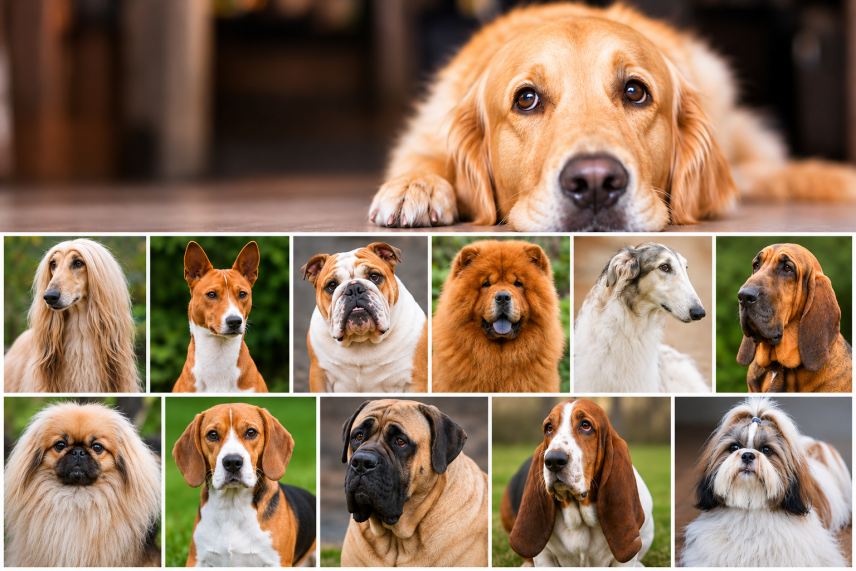
Some breeds frequently appear near the bottom of Stanley Coren's well-known ranking, including the Afghan Hound, Basenji, English Bulldog, Chow Chow, Borzoi, Bloodhound, Pekingese, Beagle, Mastiff, Basset Hound, and Shih Tzu. Calling these dogs “dumb” would be misleading. The ranking is better understood as a simplified description of how responsive certain breeds tend to be to traditional obedience training.
Understanding that distinction matters. A dog's breed history, instincts, motivation, health, age, socialization, previous experiences, environment, emotional state, and training approach can all influence how easily they learn and respond. A dog that is harder to train is not necessarily a dog with lower cognitive ability.
Which Dog Breeds Are Considered the Least Intelligent?
When people search for the least intelligent dog breeds, they are often looking for the breeds that appear near the bottom of Stanley Coren's ranking of working and obedience intelligence. The commonly cited group includes:
- Afghan Hound
- Basenji
- English Bulldog
- Chow Chow
- Borzoi
- Bloodhound
- Pekingese
- Beagle
- Mastiff
- Basset Hound
- Shih Tzu
This should not be treated as a list of “dumb dogs.” It is a simplified ranking of a particular aspect of behavior: how readily dogs learn and perform commands in an obedience context.
That distinction is especially important for breeds with strong working instincts. A Beagle following an interesting scent or a Bloodhound concentrating intensely on a trail is demonstrating a highly developed ability. A sighthound independently responding to movement is also using a skill shaped by generations of selective breeding.
In other words, a dog can be less responsive to repeated obedience drills while being exceptionally capable in another area.
What Does Intelligence Mean in Dogs?
Dog intelligence is not a single measurable trait. Dogs can display different types of cognitive ability, and their performance can vary depending on the task, environment, motivation, and relationship with the person asking them to perform it.
Instinctive intelligence
Instinctive intelligence refers to abilities associated with the tasks for which a breed was originally developed. Depending on the breed, this may include scent tracking, hunting, herding, guarding, retrieving, or detecting movement.
A Bloodhound's ability to work with scent is an obvious example. A Beagle's interest in following a scent trail is another. Sighthounds have historically been selected for detecting and pursuing moving prey, while herding breeds have been selected for sensitivity to movement and the ability to control livestock.
These abilities cannot meaningfully be reduced to how quickly a dog learns “sit” or “stay.” They represent different forms of performance.
Adaptive intelligence
Adaptive intelligence describes how a dog learns from experience and responds to new situations. It can include finding solutions to problems, changing strategies, remembering what has worked before, and adapting behavior to a particular environment.
This form of intelligence can be easy to overlook in independent dogs. A dog that does not wait for a person to provide a solution may appear stubborn when they are actually using their own strategy.
Self-directed behavior is not automatically a sign of poor cognitive ability. In some breeds, independence was an important part of the work they were originally expected to perform.
Working and obedience intelligence
Working and obedience intelligence concerns how readily a dog learns from humans and how reliably they respond to learned cues.
This is the area most commonly represented in popular dog intelligence rankings. It can include how many repetitions a dog needs to learn a new command and how consistently they respond when the cue is given.
This type of learning is certainly useful in everyday life. However, it is only one part of canine cognition. A dog may be less motivated to repeat obedience exercises while having excellent memory, scent abilities, problem-solving skills, environmental awareness, or social understanding.
Where Does the Dog Intelligence Ranking Come From?
Stanley Coren's ranking
Psychologist Stanley Coren popularized the subject of canine intelligence through his book The Intelligence of Dogs. His framework discussed different forms of intelligence, including instinctive intelligence, adaptive intelligence, and working and obedience intelligence.
The ranking that became particularly famous was based on working and obedience performance. Because it is easy to understand and compare, it has been widely repeated in articles and online lists about dog intelligence rankings.
The problem arises when a ranking of one specific ability is presented as though it were a complete measurement of a dog's mind.
How dog breeds were assessed
Coren's well-known ranking drew on assessments from obedience judges and considered factors such as how many repetitions a breed typically needed to learn a new command and how reliably dogs responded to a known command.
Breeds that were reported to learn commands more slowly or respond less consistently appeared lower in the ranking.
This can provide useful context for people interested in training. It does not, however, establish that one breed has greater overall cognitive ability than another.
Why obedience does not measure all canine intelligence
Obedience tests depend on more than the ability to understand a command. They also depend on motivation, attention, the value of the reward, the surrounding environment, the dog's relationship with the handler, and the dog's willingness to cooperate.
An independent dog may understand a cue but decide that another behavior is more valuable in that particular moment. A scent hound may focus intensely on an odor. A hunting breed may respond strongly to movement. A guarding breed may pause to assess a situation rather than immediately follow a direction.
For that reason, a dog intelligence ranking based on obedience should be treated as information about trainability in a particular context, not as a universal intelligence scale.
Dog Breeds Often Considered Harder to Train
The following breeds frequently appear in discussions of the hardest dog breeds to train. Their lower position in obedience-based rankings is better explained by independence, motivation, breed history, or strong instincts than by a lack of intelligence.

Afghan Hound
The Afghan Hound appears at the bottom of Stanley Coren's well-known working and obedience ranking. This does not mean that the breed has poor cognitive abilities.
Afghan Hounds were developed as hunting dogs and had to work with a considerable degree of independence. They were not bred primarily to wait for a human to issue a sequence of commands and then repeat those commands on demand.
A common training challenge is selective motivation. An Afghan Hound may understand what is being asked but have little reason to perform the behavior repeatedly.
Its strengths include independence, environmental awareness, athletic ability, and strong visual responses to movement.
Training tip: Keep sessions short and rewarding. Use high-value rewards and avoid turning training into repetitive drilling.
The breed can suit an experienced owner who appreciates an independent temperament and does not expect constant, automatic obedience.
Basenji
The Basenji is another breed often listed among the least trainable dog breeds in popular discussions. Its history is associated with hunting and independent work.
This background helps explain why a Basenji may not always be eager to repeat a behavior simply because a person asks. The dog may be curious about something else in the environment or may see little value in continuing the exercise.
Basenjis can be curious, observant, and capable of independent problem-solving. Their self-directed nature is part of what makes the breed distinctive.
Training tip: Use food, play, scent games, and short exercises to make cooperation worthwhile.
A Basenji may be a good match for an owner who enjoys working with an independent dog and is willing to adapt training rather than expecting automatic compliance.
English Bulldog
The English Bulldog often appears in lists of dogs considered more challenging to train. Repetitive exercises may not always provide enough motivation, particularly when the dog sees little reason to continue.
The breed's historical development involved physically demanding work requiring determination and strength. Modern English Bulldogs are primarily companion dogs, with individual activity levels varying considerably.
Training should take the individual dog's physical condition into account. Long or strenuous sessions are not necessary to achieve useful everyday skills.
Strengths can include persistence, a generally companion-oriented temperament, and the ability to form strong bonds with people.
Training tip: Use very short sessions and reward behaviors that are useful in everyday life. Adjust activity to the dog's physical abilities.
The breed may suit someone looking for a companion rather than a high-performance working or sporting dog.
Chow Chow
The Chow Chow is often described as independent and sometimes aloof. Historically, the breed was associated with guarding, hunting, and other tasks in which some degree of self-direction was useful.
This can create a training challenge when a person expects enthusiastic repetition of commands. A Chow Chow may not see every requested behavior as equally worthwhile.
Its strengths can include independence, environmental awareness, and a calm, self-directed approach to unfamiliar situations.
Training tip: Use clear cues, predictable routines, and reward-based training. Avoid confrontational methods that can damage trust.
A Chow Chow may suit an experienced owner who understands independent temperaments and is comfortable with a dog that does not constantly seek direction from people.
Borzoi
The Borzoi is a sighthound developed for hunting, with speed and visual detection of moving prey playing important roles in its working history.
A dog bred to notice and respond rapidly to movement is not necessarily going to behave like a breed selected for close, continuous cooperation with a handler.
A strong prey drive can make certain training situations particularly challenging, especially when the dog notices something moving quickly.
The Borzoi's strengths include speed, visual awareness, athleticism, and a distinctive independent temperament.
Training tip: Build recall gradually in secure environments and increase distractions only when the response is reliable.
The breed may suit owners who understand sighthound behavior and can provide safe opportunities for exercise without relying on perfect off-leash obedience.
Bloodhound
The Bloodhound is one of the clearest examples of why the term least intelligent dog can be misleading.
This breed is highly specialized for scent work. Its historical role involved following scent trails, and strong concentration on an odor can naturally compete with a handler's request for attention.
A Bloodhound that appears to ignore a cue while following an interesting scent is not necessarily failing cognitively. It may simply be intensely engaged in an activity for which it has remarkable natural ability.
Its major strength is scent work, including persistent tracking behavior.
Training tip: Incorporate nose work and scent-based games into training rather than treating the dog's interest in smells as purely unwanted behavior.
A Bloodhound may suit an owner who enjoys scent work and understands the demands of living with a large, independent hound.

Pekingese
The Pekingese was developed primarily as a companion dog. Its historical role did not require the same degree of sustained obedience work expected from many modern working breeds.
As a result, repetitive training can sometimes be less motivating. The dog may learn a behavior but show limited enthusiasm for performing it over and over.
Its strengths include adaptability to companion-dog life, attentiveness to its owner, and a distinctive personality.
Training tip: Keep exercises brief, use clear cues, and reward the specific behaviors you want to see more often.
The Pekingese may suit an owner looking for a small companion who does not require intensive working-dog training.
Beagle
The Beagle is frequently described as one of the more stubborn dog breeds, but its behavior makes much more sense when its hunting history is considered.
Beagles were bred to hunt and work with their noses. When a compelling scent is present, following that scent can be highly rewarding and biologically important to the dog.
This can make recall and attention difficult in environments full of interesting smells.
At the same time, the Beagle's curiosity, persistence, and scenting ability are significant strengths.
Training tip: Use food rewards and scent-based games to turn the dog's natural interest in searching into an advantage during training.
A Beagle can suit an active owner who enjoys engaging a dog through exploration, scent work, and structured activities.
Mastiff
Mastiffs have historically been associated with guarding, protection, and other tasks where independent judgment and a calm presence could be valuable.
A large, steady dog may also work at a different pace from breeds selected for rapid responses to repeated commands.
A common training challenge is motivation. A Mastiff may not see the point of repeating an exercise many times, particularly if the reward is not meaningful to that individual.
Strengths can include calmness, observation, and a steady temperament.
Training tip: Focus on practical behaviors that improve everyday life and use short, predictable sessions with appropriate rewards.
A Mastiff is generally better suited to an owner who understands the responsibilities of living with a very large dog than to someone seeking effortless obedience.
Basset Hound
The Basset Hound is another scent-focused breed that can appear in discussions of hardest dog breeds to train.
Basset Hounds were developed for hunting and scent tracking. Once an interesting odor captures their attention, it can be difficult to redirect them immediately.
This can look like stubbornness from a human perspective, but the same trait contributes to their persistence in scent-based work.
Their strengths include scenting ability, persistence, and an ability to remain engaged with a trail.
Training tip: Use food-based search games and controlled scent activities to build engagement before gradually introducing more distractions.
A Basset Hound may suit a patient owner who appreciates a distinctive, slower-paced companion and is prepared to work around strong scent interests.
Shih Tzu
The Shih Tzu is another breed that appears toward the lower end of popular obedience-based rankings. Historically, it was primarily developed as a companion dog rather than for complex working tasks.
This can mean that repetitive obedience exercises are not always especially motivating. A Shih Tzu may learn a behavior without being eager to perform it repeatedly.
Its strengths include adaptability to household life, sociability, and the ability to form close relationships with people.
Training tip: Keep sessions short, reward generously, and use behaviors that have an obvious practical purpose.
The breed can be a good match for someone seeking a companion dog rather than a demanding working or sporting partner.
Why Is an Independent Dog Not Less Intelligent?
A dog may understand a cue and choose not to respond
Understanding a cue and responding to it are not identical abilities. A dog may know what “come” means but fail to respond when the environment contains a powerful distraction.
Excitement, fear, fatigue, competing smells, unfamiliar surroundings, or insufficient reinforcement can all affect whether a learned behavior is performed.
That is why a single failure to respond should not be treated as proof that a dog does not understand the cue.
Breed instincts influence behavior
Selective breeding has shaped dogs for particular jobs. Herding dogs notice movement. Scent hounds investigate odors. Sighthounds respond strongly to visual movement. Guarding breeds may assess their surroundings before acting.
These tendencies can sometimes conflict with the behavior a person wants in a particular moment.
A dog's natural priorities therefore matter when interpreting behavior. What looks like stubbornness may sometimes be a predictable expression of the dog's breed-related motivation.
Motivation and context matter
Dogs do not learn in a vacuum. A behavior that is reliable in a quiet room may be much harder to perform in a busy park.
Rewards also differ between individuals. Food may be highly motivating for one dog, while another may work more enthusiastically for play, access to a preferred activity, movement, or social interaction.
Good training considers what makes cooperation worthwhile for that particular dog.
Every dog is an individual
Breed tendencies are useful for setting expectations, but they cannot predict the personality or learning potential of every individual dog.
Two dogs from the same breed can differ significantly in confidence, motivation, sociability, sensitivity, energy level, and response to training.
Genetics matter, but so do early experiences, socialization, health, age, environment, previous learning, and the quality of the relationship with the handler.
What Does Research Say About Dog Intelligence and Breed?
Research into canine cognition indicates that breeds can differ in specific cognitive and behavioral tasks. However, these findings do not produce one universally accepted scale that places every breed from “smartest” to “least intelligent.”
Different tests examine different abilities. A study might assess social cognition, impulse control, problem-solving, memory, persistence, or responses to human communication. A dog can perform strongly in one area and less strongly in another.
This supports the idea that canine cognition is multidimensional. There is no single skill that captures everything a dog is capable of understanding or doing.
Research also needs to be interpreted at the group level. If a particular breed shows a tendency in a controlled test, that does not mean every individual dog of that breed will behave the same way.
Breed can therefore provide useful information about likely tendencies, but it only partly predicts an individual dog's behavior. Socialization, health, age, previous experiences, environment, emotional state, reinforcement history, and training methods all matter.
How to Train a Dog Seen as Stubborn or Independent
Keep sessions short and predictable
Short sessions are often easier for dogs to handle than prolonged repetition. End while the dog is still engaged rather than waiting until attention has completely disappeared.
Begin with behaviors the dog can perform successfully, then gradually increase difficulty.
Use rewards that matter to the dog
A reward only works as reinforcement if the dog actually values it. For some dogs, food is highly effective. Others may prefer play, access to a favorite activity, movement, or social interaction.
If a dog ignores a treat outside, the issue may not be stubbornness. The environment may simply be more rewarding or the training may be too difficult at that moment.
Begin with fewer distractions
Teach new behaviors in a quiet environment before expecting them to work reliably in a stimulating setting.
Once the dog understands the behavior, gradually introduce distractions. This helps the dog learn that the cue remains meaningful even when the environment changes.
Avoid repeating cues endlessly
If a person repeats “come” again and again while the dog continues doing something else, the signal can become less meaningful.
Give the cue when you have a reasonable chance of success. If the dog does not respond, adjust the environment, distance, distraction level, or reward rather than simply saying the cue louder or more often.
Work with the dog's natural abilities
Breed-related interests can become valuable training tools. Scent hounds may enjoy search games. Sighthounds may benefit from safe movement-based activities. Companion breeds may be especially motivated by social interaction.
Working with a dog's natural interests can increase engagement and reduce unnecessary conflict during training.
Build a reliable recall gradually and safely
Recall deserves particular attention in dogs with strong prey drive or scent motivation. It should be built gradually rather than tested in the most difficult possible environment.
Start indoors or in a secure area, then increase distance and distractions step by step. In open areas, safety should take priority over testing whether the dog will obey a difficult recall.
When to consult a qualified trainer or behavior professional
Professional help can be valuable when a training problem persists despite consistent work or when a dog shows fear, aggression, severe reactivity, or significant difficulty coping with everyday situations.
A sudden change in behavior also deserves veterinary attention because pain or illness can affect concentration, tolerance, and responses to people or other animals.
A qualified professional should assess the underlying cause and use humane, reward-based methods. Punishment, intimidation, dominance-based approaches, and aversive tools are not necessary foundations for effective training.
Which Dog Breed Is Best for a First-Time Owner?
There is no single best dog breed for first-time owners. A breed that learns commands quickly may still be a poor match for someone who cannot meet its exercise, social, grooming, or mental stimulation needs.
Before choosing a dog, consider the whole picture rather than a single intelligence ranking.
- Lifestyle: How much time is available for walks, training, and companionship?
- Activity level: Does the household prefer quiet routines or an active lifestyle?
- Grooming: Can the owner manage the breed's coat and grooming requirements?
- Health: Are the breed's known health considerations understood and financially manageable?
- Size: Is the dog's adult size suitable for the home and daily routine?
- Budget: Can the household comfortably cover food, veterinary care, grooming, training, and unexpected expenses?
- Training time: Can the owner provide consistent, patient training?
- Household needs: Are there children, other pets, frequent visitors, or other considerations?
- Experience: Is the owner prepared for the breed's typical instincts and temperament?
The right first dog is not necessarily the breed that ranks highest for obedience. It is the dog whose needs, temperament, and likely behavior fit the owner's real-life circumstances.
Frequently Asked Questions About the Least Intelligent Dog Breeds
1. What is the least intelligent dog breed?
The Afghan Hound is commonly placed at the bottom of Stanley Coren's well-known ranking of working and obedience intelligence. This does not establish that the breed has the lowest overall intelligence. The ranking focuses on learning and responding to commands, while canine cognition includes many other abilities, such as scent work, problem-solving, memory, and environmental awareness.
2. Is the Afghan Hound really unintelligent?
No. The Afghan Hound is an independent hunting breed whose historical work involved considerable self-direction. A lower response to repetitive obedience exercises does not demonstrate poor cognitive ability. The breed may simply be less motivated by human-directed repetition than dogs specifically bred for close cooperation and rapid response to commands.
3. Is a Beagle dumb or just independent?
A Beagle should not be described as dumb. Its strong scenting ability and hunting background can make following an interesting trail highly rewarding. This may compete with human-directed cues during walks or training. The same trait that can make recall challenging also gives the Beagle an important natural strength in scent work and searching activities.
4. Why are Basenjis difficult to train?
Basenjis are often considered challenging because they are independent and were historically used for hunting tasks requiring self-directed behavior. They may have little interest in repeating a command without sufficient motivation. Short sessions, meaningful rewards, and activities that engage their curiosity can make training more effective than prolonged repetitive drills.
5. Are Chow Chows intelligent?
Yes. A Chow Chow can learn and solve problems, but it may not show the same enthusiasm for obedience work as breeds selected for close human cooperation. Its independent temperament can make training feel slower or less direct. A lack of willingness to repeat commands should not automatically be interpreted as a lack of cognitive ability.
6. Can a Basset Hound learn commands?
Yes. Basset Hounds can learn basic commands and useful household behaviors. Their strong scent orientation can make maintaining attention more difficult, especially outdoors. Training is usually easier when new skills are taught in low-distraction environments first, followed by gradual increases in difficulty. Food rewards and scent-based activities can also provide useful motivation.
7. Can every dog be trained?
Every dog can learn, but not every dog will learn every behavior at the same speed or perform it under every condition. Age, health, temperament, experience, motivation, environment, and training history all influence learning. Effective training focuses on realistic, useful behaviors and adapts the approach to the individual dog.
8. Does a dog understand a command if they do not respond?
Not necessarily. A dog may understand a cue but fail to respond because of distraction, fear, excitement, fatigue, competing motivation, or a training environment that is too difficult. Before assuming the dog does not understand, consider whether the behavior works reliably in easier conditions and whether the cue has been reinforced consistently.
9. What affects a dog's intelligence?
Canine cognitive ability is influenced by multiple factors, including genetics, breed tendencies, individual temperament, age, health, experience, socialization, environment, and learning history. Research supports differences between breeds in specific cognitive tasks, but there is no single measure that captures every aspect of a dog's intelligence or predicts the abilities of every individual.
10. Does dog breed determine personality?
No. Breed can influence the likelihood of certain behavioral tendencies, but it does not determine the personality of every individual dog. Dogs within the same breed can differ in confidence, sociability, motivation, sensitivity, activity level, and learning style. Individual development, experiences, socialization, health, and environment also contribute significantly to behavior.
11. Which dogs are easier for first-time owners to train?
There is no universally easiest breed for every first-time owner. Breeds selected for cooperation may often respond well to structured training, but ease of training is only one consideration. Activity level, grooming, health, size, social needs, prey drive, budget, and the owner's available time should all be considered before choosing a dog.
12. When should I work with a dog trainer or behavior professional?
Professional help is appropriate when training problems persist, when a dog shows fear, aggression, severe reactivity, or difficulty coping with everyday situations, or when the owner is unsure how to proceed. A sudden behavior change also warrants veterinary attention. A qualified professional can identify contributing factors and develop an individualized, reward-based training plan.
Key Takeaways
- “Least intelligent dog breeds” is an oversimplified phrase, not a scientifically definitive category.
- Popular rankings mainly assess working and obedience intelligence, rather than every aspect of canine cognition.
- An independent or difficult-to-train dog is not necessarily less capable of learning or problem-solving.
- Scent ability, prey drive, independence, and self-directed behavior can be important breed strengths.
- Breed influences behavioral tendencies but does not completely predict an individual dog's personality or learning potential.
- Motivation, environment, health, age, socialization, experience, and training methods all affect performance.
- The most effective training is individualized, predictable, reward-based, and adapted to the dog's natural abilities.
The question behind searches for the least intelligent dog breeds therefore deserves a more nuanced answer than a simple ranking. Some dogs are less responsive to repetitive obedience training, but that does not mean they have fewer cognitive abilities. They may simply be highly specialized, independent, or motivated by things that are different from what the human trainer is asking them to do.
Instead of asking whether a dog is “smart” or “dumb,” it is more useful to ask what the dog is naturally good at, what motivates them, and under which conditions they learn best. This perspective is not only fairer to the dog; it also leads to more effective training and a better understanding of canine behavior.
Comparison:
| Breed | Why training may be more challenging | Typical strength | Practical training tip |
|---|---|---|---|
| Afghan Hound | Independent temperament and strong prey drive | Visual awareness, athleticism, self-direction | Keep sessions short and highly rewarding |
| Basenji | Self-directed behavior and selective motivation | Curiosity and independent problem-solving | Use food, play, and scent-based activities |
| English Bulldog | May have limited interest in repetitive drills | Persistence and companion-dog qualities | Use short sessions suited to physical ability |
| Chow Chow | Independent and sometimes less motivated by commands | Self-direction and environmental awareness | Use clear routines and reward-based training |
| Borzoi | Strong prey drive and independent working style | Speed and visual detection | Build recall gradually in secure areas |
| Bloodhound | Strong focus on scent trails | Exceptional scent work and persistence | Incorporate nose work into training |
| Pekingese | May lose interest in repetitive exercises | Companion-dog adaptability | Use brief sessions and meaningful rewards |
| Beagle | Strong scent motivation and hunting instincts | Scent work and persistence | Use food rewards and search games |
| Mastiff | Calm pace and independent motivation | Steadiness and observation | Focus on practical behaviors and short sessions |
| Basset Hound | Strong orientation toward scents | Scent tracking and persistence | Use search games and gradual recall training |
| Shih Tzu | May be less motivated by repetitive obedience work | Companion-dog adaptability and sociability | Keep training short and reward desired behavior |
Read more:
Why Does My Dog Pee When Greeting People? Causes and What to Do
How to Keep Your Dog Safe During Hot Weather
What Can’t Dogs Eat? A List of Toxic Foods and Safe Alternatives
Rabies – Mandatory Dog Vaccinations and the Importance of Identification